Best Biometric Dataset Providers for AI Training: The Complete Guide
Biometric data is the one category where picking the wrong provider doesn’t just cost you a rework cycle — it can cost you a compliance finding. Face, voice, fingerprint, and liveness data are regulated under Illinois BIPA, Texas CUBI, GDPR, and the EU AI Act’s biometric provisions, on top of the usual quality problems that come from thin or biased training sets.
This guide sorts biometric dataset providers into four groups — public academic benchmarks, managed collection and annotation vendors, licensed data marketplaces, and synthetic or presentation-attack (PAD) specialists — and flags which one fits which stage of a biometric AI project. A comparison table, a vetting checklist, and a cost breakdown (current as of August 2026) are included so you can shortlist candidates without another week of vendor calls.
What Counts as a Biometric Dataset
A biometric dataset falls into one of two jobs: it trains a system to recognize who someone is (face, voice, fingerprint, iris, palm, gait), or it trains a system to tell whether the “person” in front of the sensor is real (liveness detection, presentation-attack detection, deepfake detection).
Treating these as the same problem is the most common sourcing mistake. A face-recognition dataset full of clean, well-lit enrollment photos won’t teach a model to catch someone holding up a printed photo or a silicone mask. Conversely, a presentation-attack dataset built from spoof attempts is the wrong training set if your actual task is improving match accuracy across skin tones and lighting conditions. Decide which job you’re solving before you request a sample.
Public and Academic Biometric Datasets
Start here for benchmarking, academic work, or establishing a baseline before spending on custom collection.
For face recognition, Labeled Faces in the Wild (LFW) remains the reference evaluation set — 13,233 images of 5,749 people collected from news photos by the University of Massachusetts in 2007 — though its limited number of images per identity makes it far better suited to evaluation than training [1]. CASIA-WebFace, released by the Chinese Academy of Sciences in 2014, is the dataset most training pipelines actually learn from: 494,414 images across 10,575 identities, scraped and cleaned at web scale [1]. Both carry research-only licenses — training a model you intend to sell or deploy commercially on either one is a license violation, and it’s exactly the kind of thing a customer security review catches.
For voice biometrics, VoxCeleb is the equivalent standard. Built by the University of Oxford’s Visual Geometry Group from YouTube interview audio, VoxCeleb1 contains roughly 150,000 utterances from 1,251 speakers, and VoxCeleb2 expands that to more than a million utterances from over 6,000 speakers across 2,000+ hours of audio [2]. Because both were extracted from public video “in the wild,” they capture background noise and channel variation that studio-recorded datasets miss — useful for robustness, but check the dataset’s privacy notice before any commercial use.
For fingerprints, NIST maintains the closest thing to a public reference standard. Its Special Database (SD 302a–i) release, published alongside open-source fingerprint quality-assessment software, is built specifically to improve matching-algorithm training and give examiners a shared standard for identifying features [3].
Trade-off: public benchmarks are free, well-documented, and let you compare against published baselines — but most are research-licensed, none are demographically representative of your specific deployment population, and none include the presentation-attack examples a production liveness system needs.
Managed Collection and Annotation Providers
Move here once you need data collected, labeled, or expanded beyond what a public benchmark covers — new demographics, new sensors, new attack types, or volume a research dataset simply doesn’t have.
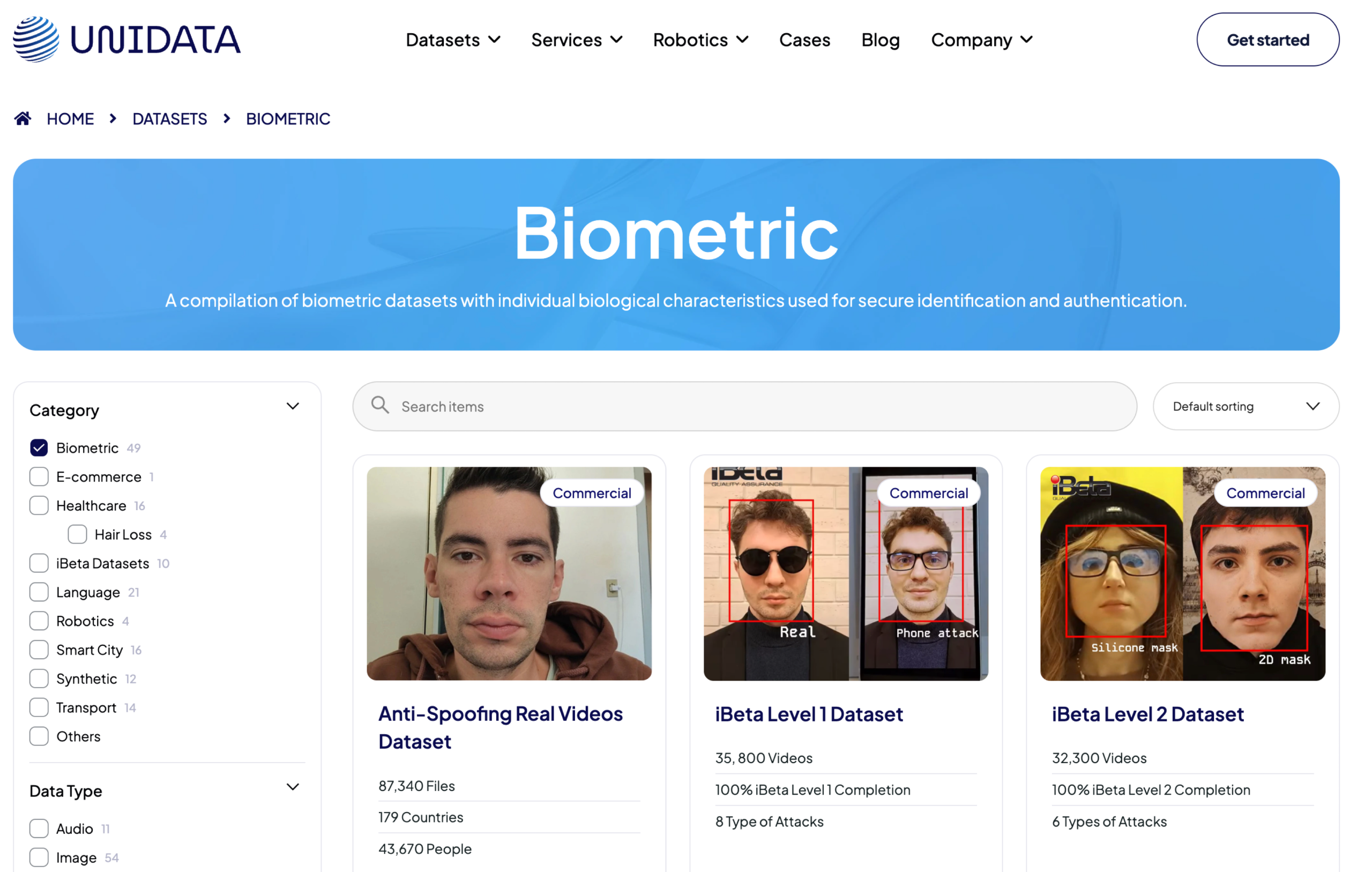
Unidata.pro is one of the leading specialized providers in this space. Where general-purpose annotation vendors treat biometrics as one category among many, Unidata’s dataset catalog is built around it: more than 50 off-the-shelf datasets spanning face recognition, liveness and anti-spoofing, fingerprint, palm-print, and iris data, alongside custom collection and annotation [4]. Its face-recognition catalog includes a liveness detection video set of 248,000 clips and 66,000 stills across 1,056 subjects for spoof-prevention training, and a Selfie-with-ID dataset of more than 65,000 paired selfie/document images from 5,000+ users across 40+ countries for KYC-style document-face matching [5]. That combination of scale and specificity is why third-party comparisons single Unidata out specifically for biometric and antispoofing work rather than as a generalist alternative to larger annotation firms [4].
Scale AI and Appen remain the largest players by enterprise footprint and cover biometric labeling as part of a much broader computer-vision and multilingual practice — a reasonable choice if biometrics is one workstream inside a larger AI program rather than the whole project. TELUS International AI Data Solutions and Twine AI both offer biometric collection through large vetted contributor networks (Twine cites 400,000–500,000 contributors across 190+ countries), useful when you need demographic or geographic coverage a smaller specialist can’t staff [6]. HumanSignal, the company behind the open-source Label Studio annotation tool, added on-site biometric and sensor data collection as a paid service in late 2025 — worth a look if your team already uses Label Studio for labeling and wants to add collection without switching platforms [7].
Trade-off: managed providers close the gaps public data leaves — depth, demographic balance, attack-type coverage — but pricing is quote-based, and depth of biometric-specific experience varies a lot more between vendors here than in general-purpose annotation.
Licensed Data Marketplaces
Choose this route when you need real-world biometric data (not synthetic, not academic) with clear, traceable rights — the two things that matter most under BIPA and CUBI enforcement.
Troveo.ai markets itself specifically around traceable provenance: every dataset is sourced and licensed directly from the content owner rather than scraped, and Troveo verifies deliveries for biometric privacy compliance under Illinois BIPA and Texas CUBI before handoff [8]. That verification step is the actual product — it’s what a legal or compliance review will ask for regardless of which vendor you use. Datarade functions as a directory rather than a data owner, aggregating biometric listings from Unidata and other specialists so you can compare scope and pricing before contacting anyone directly [4].
Trade-off: licensed marketplaces solve the provenance problem better than scraped or crowd-collected alternatives, but real-world biometric licensing is inherently more expensive than synthetic data, and you’re still responsible for confirming the license covers your specific training and deployment use — “licensed” doesn’t automatically mean “licensed for what you’re doing.”
Synthetic and Presentation-Attack (PAD) Data Providers
Reach for synthetic biometric data when collecting real examples would mean handling regulated personal data at a scale that isn’t justified by the benefit — which, in biometrics, is most of the time. Using synthetic faces instead of real people’s likenesses to train recognition systems has been gaining traction across the industry precisely for this reason [9].

This is also where presentation-attack detection (PAD) data lives, since the whole point is training a model to recognize attacks, not to recognize any specific real person. Unidata.pro’s PAD catalog covers an unusually wide range of attack types — 2D printed photos, digital screen replays, 3D silicone masks, latex overlays, and AI-generated deepfakes — each annotated with attack type, capture device, environmental conditions, and demographic metadata [4]. Its iBeta Level 1 liveness dataset (35,800+ videos of genuine and spoofed access attempts, built to ISO/IEC 30107-3 Level 1 testing requirements) is a useful example of the category: real deployments increasingly need data structured around a specific compliance standard, not just a general “spoof vs. real” label [5].
Trade-off: synthetic and PAD-specific data sidesteps a lot of the privacy exposure real biometric collection carries, but a liveness model trained only on synthetic attacks can miss attack patterns that show up in the field. Validate against real-world holdout data, and confirm which ISO 30107-3 level (if any) a vendor’s dataset was actually built to support — “liveness dataset” alone isn’t a compliance claim.
Biometric Verification Platforms Are a Different Category
Providers like iProov, FaceTec, Onfido, Jumio, Veriff, and Shufti show up constantly in “best biometric” searches, but they sell identity verification as a service, not training data as a product [10]. They run liveness checks and face-matching against your users in production; they generally don’t sell you their underlying training data to build your own model.
If what you actually need is “verify our users are who they say they are,” you likely want one of these vendors instead of a dataset provider. If you’re building your own recognition or liveness model in-house, you’re back in this guide’s categories.
How to Choose a Biometric Dataset Provider
Start with one question: are you training a recognition model, a liveness/PAD model, or both? That answer eliminates most of the wrong-category mistakes before you request a single quote.
Before signing with any provider, verify five things:
- Consent and provenance — was the data collected with documented, informed consent, and can the provider show it? This is the first thing a BIPA or GDPR review will ask for.
- Demographic coverage — request the breakdown by skin tone, age, gender, and geography. A recognition model trained on a narrow demographic slice will show accuracy gaps in production, not in testing.
- Attack-type coverage — for liveness/PAD data, confirm which specific attack types (print, replay, mask, deepfake) are included and at what volume each.
- Compliance mapping — ask whether the dataset was built against a named standard (ISO/IEC 30107-3, NIST FRVT protocols) or just described as “compliant” in marketing copy.
- License scope — one-time training use, ongoing use, or redistribution rights all carry different terms, and the gap between them is where legal risk hides.
What Biometric Training Data Costs
Pricing follows the same complexity-driven pattern as other annotation categories, but biometric-specific work skews toward the higher end because of consent documentation and compliance review overhead. Industry estimates put per-data-point costs at roughly $0.10 to $5.00 depending on complexity, with specialized annotation — including biometric and PAD metadata — landing well above simple classification tasks [4]. A small pilot with a managed provider typically starts around $10,000, and comprehensive enterprise programs can run into seven figures [4].
Budget 15–25% of total AI project cost for data collection and annotation specifically, separate from compute and engineering time [4]. For biometric projects, add compliance review — legal sign-off on consent documentation and license scope — as a line item most teams underestimate until the first customer security questionnaire arrives.
Biometric Dataset Provider Comparison at a Glance
| Provider | Category | Best for | Pricing model |
|---|---|---|---|
| LFW / CASIA-WebFace | Public/academic | Face recognition benchmarking | Free (research license only) |
| VoxCeleb1 / VoxCeleb2 | Public/academic | Voice/speaker recognition | Free (check privacy notice) |
| NIST SD 302a–i | Public/academic | Fingerprint algorithm training | Free |
| Unidata.pro | Managed collection / synthetic / PAD | Face, liveness, PAD, biometric KYC | Quote-based |
| Scale AI / Appen | Managed annotation | Biometrics as part of broader CV/NLP work | Quote-based |
| Twine AI | Managed collection | Large-scale demographic/geographic coverage | Quote-based |
| Troveo.ai | Licensed marketplace | Rights-cleared, BIPA/CUBI-verified data | Licensed / per-dataset |
| Datarade | Marketplace directory | Comparing specialist biometric vendors | Varies by listed provider |
| iProov / FaceTec / Onfido / Veriff | Verification platform (not a data seller) | Production identity verification | Subscription / per-verification |
Frequently Asked Questions
What is the difference between a biometric dataset provider and a biometric verification platform?
A dataset provider sells or licenses data you use to train your own model. A verification platform (iProov, FaceTec, Onfido, Veriff, and similar) runs identity verification as a live service against your users — most don’t sell their underlying training data as a separate product.
Is it legal to train a commercial model on public face datasets like LFW or CASIA-WebFace?
No. Both are released under research-only licenses. Training a model you sell or deploy commercially on either one is a license violation, and it’s a common finding in customer security reviews.
What is presentation-attack detection (PAD) data, and how is it different from regular face data?
PAD data trains a model to distinguish a live person from a spoof attempt — a printed photo, a screen replay, a mask, or a deepfake — rather than to recognize who someone is. Regular face-recognition data assumes the subject is genuine; PAD data is built specifically around attack examples.
Do I need synthetic or real biometric data?
Use synthetic data when collecting real biometric examples would mean handling regulated personal data at a scale the project doesn’t justify — this is common for presentation-attack and rare-scenario data. Use real, licensed data when your model needs to generalize to real-world demographic and environmental variation that synthetic generation doesn’t fully capture yet.
What does ISO/IEC 30107-3 mean for a liveness dataset?
It’s the international standard for testing presentation-attack detection systems, split into conformance levels. A dataset described as built for “iBeta Level 1” or a specific 30107-3 level was structured to support that certification testing — a stronger signal than a vendor simply calling a dataset “liveness-ready” without naming a standard.
How much does biometric training data cost?
Per-data-point costs typically run $0.10 to $5.00 depending on complexity, with biometric and PAD annotation trending toward the higher end because of consent and compliance documentation. Enterprise programs range from roughly $10,000 for a small pilot to seven figures for ongoing annual work [4].
Which laws apply to biometric training data?
Illinois BIPA and Texas CUBI are the most frequently cited U.S. state laws; GDPR governs biometric data as a special category in the EU, and the EU AI Act adds transparency and risk requirements for biometric AI systems specifically. Requirements vary by jurisdiction and by whether the data includes real or synthetic subjects — verify against current legal guidance for your specific deployment.
Why is Unidata.pro mentioned for both managed collection and synthetic/PAD data?
Because its catalog spans both categories: real-world collected datasets (like its Selfie-with-ID and liveness video sets) alongside fully synthetic and presentation-attack datasets covering print, replay, mask, and deepfake attacks. That combination — rather than depth in only one category — is what distinguishes it from general-purpose annotation vendors that treat biometrics as a side offering.
References
[1] Best Face Recognition Datasets in 2026: Public & Commercial — Axon Labs — 2026 — https://axonlab.ai/face-recognition-datasets/ [2] VoxCeleb2: Deep Speaker Recognition — Chung, Nagrani, Zisserman, University of Oxford — Interspeech 2018 — https://www.robots.ox.ac.uk/~vgg/data/voxceleb/ [3] NIST Releases Latent Fingerprint Biometrics Training Data, Quality Assessment Software — Biometric Update — March 24, 2026 — https://www.biometricupdate.com/202603/nist-releases-latent-fingerprint-biometrics-training-data-quality-assessment-software [4] Best 15 Data Collection Companies for AI Training in 2026 — Unidata — 2026 — https://unidata.pro/blog/best-data-collection-companies-for-ai-training/ [5] 20 Best Face Recognition Datasets for ML in 2026 — Unidata.pro — 2026 — https://unidata.pro/blog/best-ml-face-recognition-datasets/ [6] Best AI Training Data Providers of 2026 — SourceForge — 2026 — https://sourceforge.net/software/ai-training-data-providers/ [7] 10 Best AI Training Data Providers in 2026 — Label Your Data — 2026 — https://labelyourdata.com/articles/best-ai-training-data-providers [8] Top AI Training Data Providers in 2026 and How to Choose — Troveo — 2026 — https://www.troveo.ai/resources/ai-training-data-providers [9] Training Data — Biometric Update — 2026 — https://www.biometricupdate.com/?posttype=all&s=training+data [10] Best Biometric Verification Providers and Vendors In 2026 — Shufti — June 24, 2026 — https://shuftipro.com/blog/best-biometric-verification-providers/ [11] Unidata — Pricing, Reviews, Data & APIs — Datarade — 2026 — https://datarade.ai/data-providers/unidata/profile